 news
Admin · 2026-08-19 12:32 · edited
news
Admin · 2026-08-19 12:32 · edited
August 19 – World Photography Day
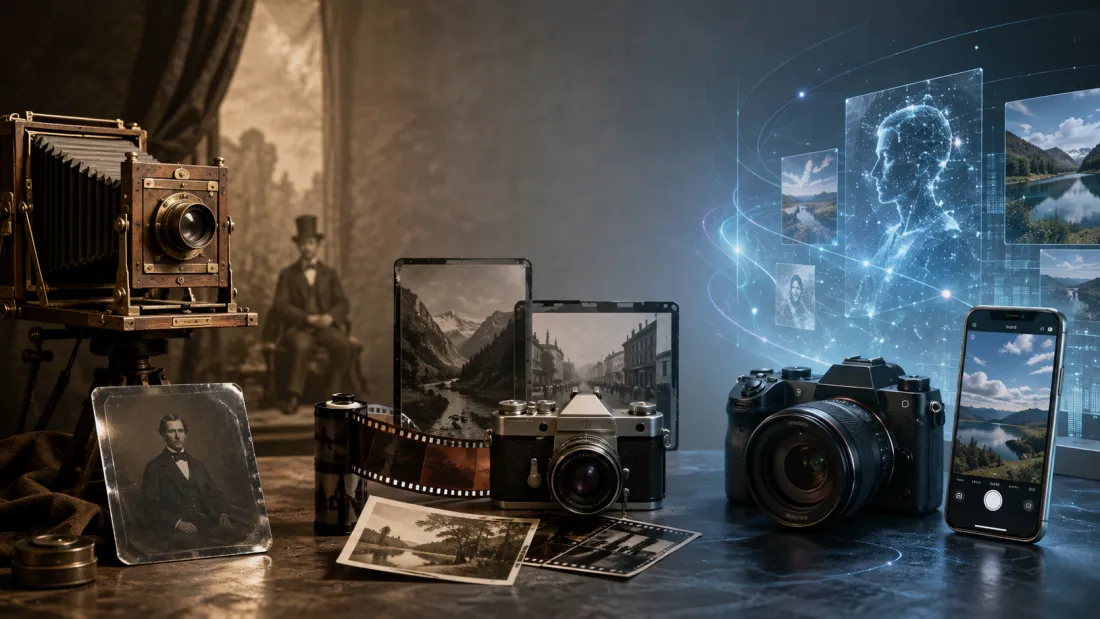
August 19 marks World Photography Day, celebrated around the world—a day dedicated not only to photographers but also to the very ability to freeze time in a single frame. Today, photography seems second nature to us: we pull our phone out of our pocket, press a button, and within a second, the image can already be on the other side of the world. But the journey to this moment has spanned nearly 200 years.
One of the earliest examples of photography is considered to be “View from the Window at Le Gras,” created in 1827 by the French inventor Joseph Nicéphore Niépce. It is the oldest surviving photograph, taken with the aid of a camera obscura. To capture this seemingly simple view through a window, the light-sensitive plate remained in the camera for several hours—according to researchers, the exposure may have lasted as long as several days.
A few years later, Louis Daguerre perfected the process into the daguerreotype. On August 19, 1839, in France, the new photographic method was publicly announced and made freely available to the world. That is precisely why August 19 later became the date on which World Photography Day is celebrated.
The daguerreotype was not a photograph in the sense that we understand it today. The image was produced on a silver-coated copper plate, and each daguerreotype was unique—there was no negative from which multiple copies could be made. Early cameras also required very long exposure times. For cameras from 1839, even in bright sunlight, these could last anywhere from about two to ten minutes—or longer.
Latvia, too, became involved in the history of photography surprisingly early. The image of the Academia Petrina building in Jelgava, taken in 1840, is considered the first daguerreotype taken in Latvia. The Gederts Elias Jelgava History and Art Museum notes that it was taken by Borāls, a photographer of French origin. Today, the museum is housed in that same historic building.
From a Single Unique Image to a Reproducible Negative
The daguerreotype’s reign was short-lived. As early as the mid-19th century, more practical photographic processes emerged. William Henry Fox Talbot’s negative–positive method made it possible to create multiple photographs from a single negative. Meanwhile, in the 1850s, wet collodion plates paved the way for the development of ambrotype and ferrotype.
In ambrotype, the image was formed on a glass plate. In ferotype, or tintype, the photograph was made on a thin, dark-lacquered metal plate. These processes were cheaper and faster than the daguerreotype, so photography gradually became accessible to a much wider audience.
In 1888, another revolution took place. George Eastman introduced the Kodak camera with the famous slogan “You press the button, we do the rest.” The camera came preloaded with film for 100 exposures. Once the film was used up, the owner would send the entire camera to Kodak, where the film was developed, the photographs were printed, and the camera was reloaded. Photography began to transform from a complex chemical process into an everyday activity.
In 1889, the Leica I also helped transform the very style of photography. The small 35 mm camera was easy to carry and allowed for much more spontaneous photography than the large cameras of the time. The Leica I established the 24 × 36 mm frame format and became one of the tools that helped advance modern photojournalism, documentary, and street photography.
Why don’t people smile in old photographs?
One of the most popular myths in the history of photography is that people in old photographs didn’t smile because they had to sit motionless for hours.
There is some truth to this—in the very early days of photography, exposure times were indeed very long. However, technology advanced rapidly, and by the mid-19th century, exposure times for portraits were significantly shorter.
There was also a much simpler cultural explanation for the serious expressions. The photographic portrait adopted the traditions of painting, in which people wanted to appear dignified, serious, and presentable. A broad smile in a formal portrait simply did not carry the same significance as it does today.
From Film to the Digital Sensor
The next major leap occurred in the 20th century. Photographic film became increasingly high-quality; color photography, autofocus, and increasingly compact cameras emerged.
But in 1975, Kodak engineer Stephen Sasson created the first prototype of a digital camera. At that time, hardly anyone could have imagined that a few decades later, digital photography would almost completely take over everyday photography.
Today, almost everyone has a camera. Moreover, it’s often not just one, but three, four, or even more—wide-angle, telephoto, and other cameras—all in a single smartphone. A photo is taken in a fraction of a second, automatically processed, saved to the cloud, and posted on social media a moment later.
Ironically, while taking photos has never been easier from a technological standpoint, creating a truly good and lasting photograph has not become any simpler.
One of the Most Viewed Photographs in the World
It’s possible that many people don’t even recognize one of the world’s most recognizable photographs as a photograph at all.
The famous Windows XP desktop image “Bliss,” featuring a green hill and blue sky, is a real photograph. It was taken in January 1996 in California by former National Geographic photographer Charles O’Rear using a medium-format Mamiya RZ67 camera on Fujifilm Velvia film.
Microsoft later acquired the rights to use the image for Windows XP. Since Windows XP was installed on a huge number of computers worldwide, “Bliss” is often cited as one of the most viewed photographs of all time.
Photography in the Age of AI
In 2026, photography is on the verge of yet another major turning point. Cameras are already capable of automatically recognizing people and objects, selecting the focus, combining multiple shots into a single image, and—with the help of software—producing results that would have been difficult to achieve just a few years ago.
Added to this is the development of generative artificial intelligence, which is capable of creating photorealistic images even without a camera.
This only makes the question more intriguing: what, exactly, is photography?
Perhaps in the future, its value will depend less and less on technical perfection and more and more on the fact that a person with a camera was actually present in that specific place at that specific moment. A photograph is not just an image. It can be evidence, a memory, a document, and the author’s view of the world.
World Photography Day 2026
This year’s theme for World Photography Day is “HOME.” The organizers invite everyone to photograph what “home” means to them—people, a place, a country, a childhood environment, or simply a feeling.
World Photography Week 2026, meanwhile, will take place from August 12 to 26, inviting people to take photos, publish their work, and explore the creations of other photographers. The hashtags #WorldPhotographyDay, #WorldPhotographyDay2026, and #WorldPhotographyWeek are being used on social media.
And maybe today is exactly the right moment to do something a little out of the ordinary —instead of snapping another 50 random photos on your phone, consciously create a single photograph that you’d still want to see ten or twenty years from now.
Select the best one. Save it. Print it. Put it in an album or a frame. Or add a shot to your portfolio that you’ll truly be proud of.
Because cameras change, technology changes, and there are more and more images, but the main purpose of photography hasn’t changed in nearly 200 years—to preserve a moment that would otherwise be lost.
One of the earliest examples of photography is considered to be “View from the Window at Le Gras,” created in 1827 by the French inventor Joseph Nicéphore Niépce. It is the oldest surviving photograph, taken with the aid of a camera obscura. To capture this seemingly simple view through a window, the light-sensitive plate remained in the camera for several hours—according to researchers, the exposure may have lasted as long as several days.
A few years later, Louis Daguerre perfected the process into the daguerreotype. On August 19, 1839, in France, the new photographic method was publicly announced and made freely available to the world. That is precisely why August 19 later became the date on which World Photography Day is celebrated.
The daguerreotype was not a photograph in the sense that we understand it today. The image was produced on a silver-coated copper plate, and each daguerreotype was unique—there was no negative from which multiple copies could be made. Early cameras also required very long exposure times. For cameras from 1839, even in bright sunlight, these could last anywhere from about two to ten minutes—or longer.
Latvia, too, became involved in the history of photography surprisingly early. The image of the Academia Petrina building in Jelgava, taken in 1840, is considered the first daguerreotype taken in Latvia. The Gederts Elias Jelgava History and Art Museum notes that it was taken by Borāls, a photographer of French origin. Today, the museum is housed in that same historic building.
From a Single Unique Image to a Reproducible Negative
The daguerreotype’s reign was short-lived. As early as the mid-19th century, more practical photographic processes emerged. William Henry Fox Talbot’s negative–positive method made it possible to create multiple photographs from a single negative. Meanwhile, in the 1850s, wet collodion plates paved the way for the development of ambrotype and ferrotype.
In ambrotype, the image was formed on a glass plate. In ferotype, or tintype, the photograph was made on a thin, dark-lacquered metal plate. These processes were cheaper and faster than the daguerreotype, so photography gradually became accessible to a much wider audience.
In 1888, another revolution took place. George Eastman introduced the Kodak camera with the famous slogan “You press the button, we do the rest.” The camera came preloaded with film for 100 exposures. Once the film was used up, the owner would send the entire camera to Kodak, where the film was developed, the photographs were printed, and the camera was reloaded. Photography began to transform from a complex chemical process into an everyday activity.
In 1889, the Leica I also helped transform the very style of photography. The small 35 mm camera was easy to carry and allowed for much more spontaneous photography than the large cameras of the time. The Leica I established the 24 × 36 mm frame format and became one of the tools that helped advance modern photojournalism, documentary, and street photography.
Why don’t people smile in old photographs?
One of the most popular myths in the history of photography is that people in old photographs didn’t smile because they had to sit motionless for hours.
There is some truth to this—in the very early days of photography, exposure times were indeed very long. However, technology advanced rapidly, and by the mid-19th century, exposure times for portraits were significantly shorter.
There was also a much simpler cultural explanation for the serious expressions. The photographic portrait adopted the traditions of painting, in which people wanted to appear dignified, serious, and presentable. A broad smile in a formal portrait simply did not carry the same significance as it does today.
From Film to the Digital Sensor
The next major leap occurred in the 20th century. Photographic film became increasingly high-quality; color photography, autofocus, and increasingly compact cameras emerged.
But in 1975, Kodak engineer Stephen Sasson created the first prototype of a digital camera. At that time, hardly anyone could have imagined that a few decades later, digital photography would almost completely take over everyday photography.
Today, almost everyone has a camera. Moreover, it’s often not just one, but three, four, or even more—wide-angle, telephoto, and other cameras—all in a single smartphone. A photo is taken in a fraction of a second, automatically processed, saved to the cloud, and posted on social media a moment later.
Ironically, while taking photos has never been easier from a technological standpoint, creating a truly good and lasting photograph has not become any simpler.
One of the Most Viewed Photographs in the World
It’s possible that many people don’t even recognize one of the world’s most recognizable photographs as a photograph at all.
The famous Windows XP desktop image “Bliss,” featuring a green hill and blue sky, is a real photograph. It was taken in January 1996 in California by former National Geographic photographer Charles O’Rear using a medium-format Mamiya RZ67 camera on Fujifilm Velvia film.
Microsoft later acquired the rights to use the image for Windows XP. Since Windows XP was installed on a huge number of computers worldwide, “Bliss” is often cited as one of the most viewed photographs of all time.
Photography in the Age of AI
In 2026, photography is on the verge of yet another major turning point. Cameras are already capable of automatically recognizing people and objects, selecting the focus, combining multiple shots into a single image, and—with the help of software—producing results that would have been difficult to achieve just a few years ago.
Added to this is the development of generative artificial intelligence, which is capable of creating photorealistic images even without a camera.
This only makes the question more intriguing: what, exactly, is photography?
Perhaps in the future, its value will depend less and less on technical perfection and more and more on the fact that a person with a camera was actually present in that specific place at that specific moment. A photograph is not just an image. It can be evidence, a memory, a document, and the author’s view of the world.
World Photography Day 2026
This year’s theme for World Photography Day is “HOME.” The organizers invite everyone to photograph what “home” means to them—people, a place, a country, a childhood environment, or simply a feeling.
World Photography Week 2026, meanwhile, will take place from August 12 to 26, inviting people to take photos, publish their work, and explore the creations of other photographers. The hashtags #WorldPhotographyDay, #WorldPhotographyDay2026, and #WorldPhotographyWeek are being used on social media.
And maybe today is exactly the right moment to do something a little out of the ordinary —instead of snapping another 50 random photos on your phone, consciously create a single photograph that you’d still want to see ten or twenty years from now.
Select the best one. Save it. Print it. Put it in an album or a frame. Or add a shot to your portfolio that you’ll truly be proud of.
Because cameras change, technology changes, and there are more and more images, but the main purpose of photography hasn’t changed in nearly 200 years—to preserve a moment that would otherwise be lost.
💬 Comments (0)